
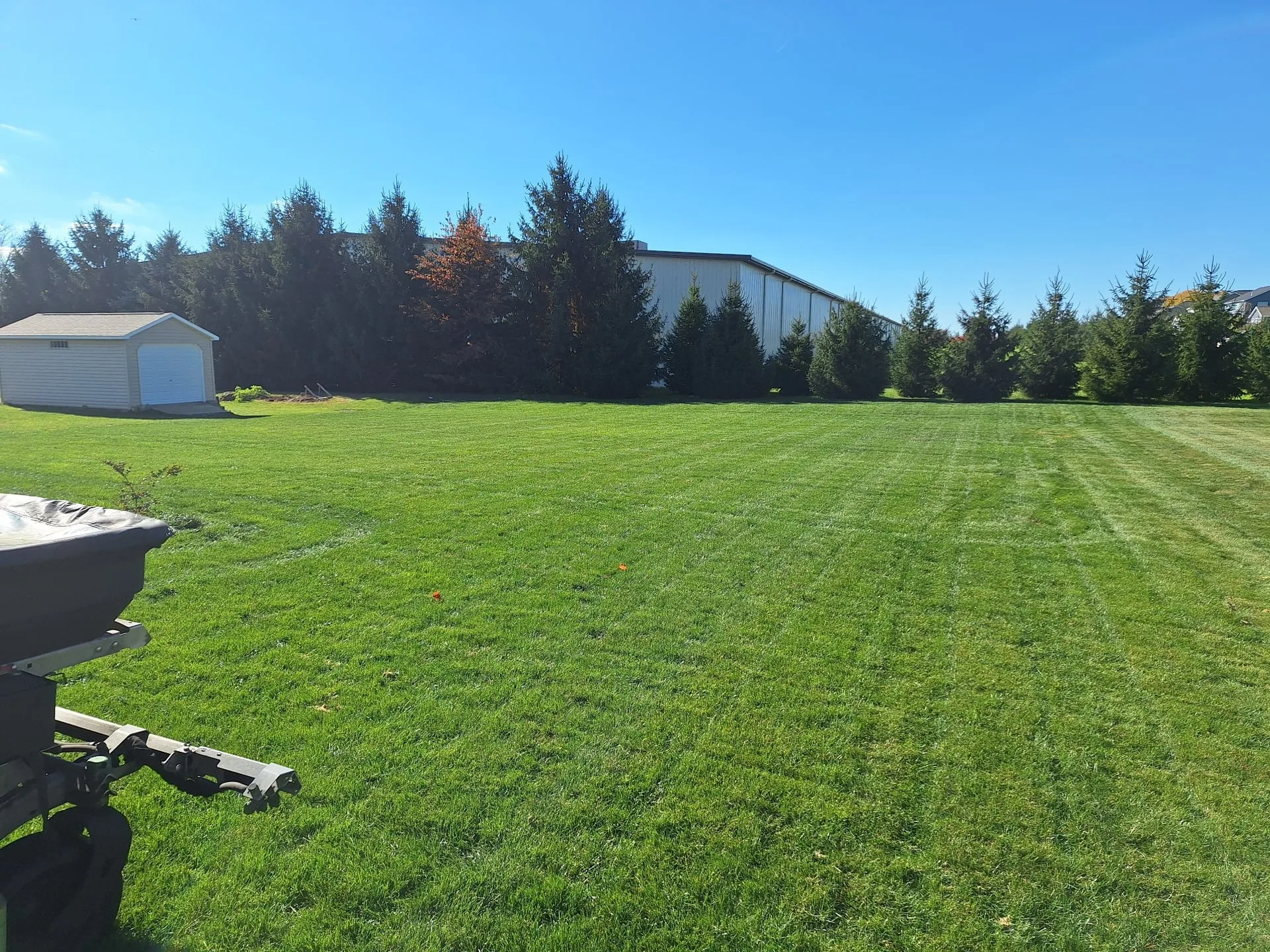
A lawn can struggle in clay soil for several different reasons. The soil may be compacted. Its pH may be too low or too high for the turf program. Organic matter may be limited. Water may move poorly through one section. Nutrient levels may not match what the grass needs. Those conditions do not all call for the same bagged product.
Portage Turf & Pest tests lawn soil for pH, nutrient levels, and organic matter, then uses the findings to tailor fertilization and soil-booster recommendations. We list lime, sulfur, gypsum, compost, and mineral boosters as separate options on our soil test and boosters page because each one has a different purpose. You should know which condition the proposed material is intended to change.
Lime raises soil pH
Lime is generally discussed when soil is more acidic than the desired range for the lawn program. We list lime as a pH-balancing treatment that raises pH in acidic soil.
The recommendation should state the current pH, target range, application rate, area treated, product, timing, whether more than one application is planned, and the retest date. Do not apply additional retail lime simply because the lawn remains pale after the professional application. A pH amendment works through soil chemistry and should be evaluated over an appropriate period. More material is not automatically a faster or better correction.
Sulfur lowers soil pH
Sulfur has the opposite pH purpose. We list sulfur for soil that is more alkaline than the desired range. You should not assume that Northeast Ohio clay is always acidic and therefore always needs lime.
Construction fill, previous amendments, imported topsoil, irrigation water, landscape history, and site differences can produce another result. When sulfur is recommended, ask which sample showed elevated pH, whether the recommendation applies to the whole lawn, how gradually the adjustment will occur, whether another application is expected, how it affects the fertilizer program, when the area will be retested, whether trees or shrubs share the same soil area, and which symptoms may have another cause. The recommendation should follow the test, not a regional stereotype.
Gypsum is not a substitute for every clay-soil problem
We list gypsum as a soil-conditioning treatment intended to improve selected clay-soil conditions without changing pH in the same way lime or sulfur does. That does not mean every hard clay lawn needs gypsum.
The technician should explain what soil condition was identified, whether the test supports the recommendation, which area needs treatment, whether compaction is also present, whether drainage is involved, whether aeration is recommended, whether construction soil is contributing, and what change should reasonably be expected. Gypsum cannot create a drainage outlet, correct grade, or remove buried construction debris. It belongs inside a specific soil plan.
Compost adds organic matter
We list compost boosters as applications intended to add organic matter, support soil structure, improve water retention, and encourage beneficial biological activity. Compost has a different job from lime or sulfur. It does not automatically correct pH.
A compost program may make sense when the soil test and lawn evaluation indicate low organic matter, weak surface structure, a poor seedbed, compacted or depleted soil, lawn renovation, a top-dressing opportunity, a need for improved moisture management, or soil rebuilding after construction. Ask how the compost will be applied. The plan may involve a thin surface layer, use after aeration, or another method appropriate to the lawn. The existing grass should not be buried under an uncontrolled amount of material. Properties comparing approaches can also review our organic lawn care options alongside the standard lawn care program.
Mineral boosters should name the mineral
Soil testing can reveal calcium and micronutrient needs and supports tailored mineral-booster recommendations. A proposal should not contain one vague line stating mineral treatment.
Ask for the mineral or nutrient, test result, product, rate, area, timing, expected purpose, follow-up, and retest. A yellow lawn may be experiencing nutrient availability problems. It may also be affected by water, disease, shade, insects, compaction, mowing, or another condition. The booster should connect to a documented finding.
Aeration addresses physical compaction
Soil chemistry and physical compaction are related but different. Core aeration creates openings through the lawn and soil. Lime, sulfur, compost, gypsum, or mineral products change or support selected soil properties. We provide aeration as a separate service and describe it as a way to improve the movement of air, water, and nutrients into compacted soil. A lawn may need both aeration and an amendment. The proposal should explain each one separately. Seeding may also belong in the same renovation window when thin turf needs more than chemistry alone.
Drainage may remain a landscape problem
A soil report can explain pH, nutrients, and organic matter. It does not fully map how water moves across the property. A repeatedly wet section may involve low grade, a downspout, neighboring runoff, a broken drainage line, irrigation overlap, a compacted trench, buried material, a poor outlet, shade, or heavy traffic.
Do not expect a soil booster to move standing water off the lawn. We can address lawn health, but a larger drainage or grading project may require another qualified landscape provider.
Sample different areas when the property behaves differently
A large lawn may not be represented well by one mixed sample when sections have different histories. Tell us about new construction, imported soil, an old garden, a septic field, a wooded section converted to lawn, a fill area, a repeatedly wet section, a repeatedly dry section, previous lime, previous sulfur, prior compost, a utility trench, and new sod.
We can determine the appropriate sampling strategy. Do not combine an obviously different construction-fill area with a long-established front lawn without discussing it first.
Keep the soil report for more than one season
Soil results describe conditions at a point in time and may deserve updating after major amendments, construction, flooding, drought, or other meaningful property changes. Save the sample date, areas sampled, pH, nutrients, organic matter, recommendations, product, rate, application date, aeration, compost, seed, retest date, and photographs. That history prevents repeated guessing and helps the next technician understand what has already been changed.
Ask what the amendment will not fix
A strong recommendation should include its limits. Lime may change pH. It will not repair a broken sprinkler. Compost may add organic matter. It will not correct a deep low spot. Gypsum may fit selected soil conditions. It will not replace aeration automatically. Sulfur may lower pH. It will not remove weeds already established in the lawn.
If you are comparing full property packages, our article on Enhanced Care, Plus, and Premium bundles shows how soil amendments sit on a separate calendar from mosquito, pest, and plant-health visits. Browse the services list, the blog, or contact us at (330) 296-8873. Portage Turf & Pest serves Portage, Summit, Geauga, and surrounding Northeast Ohio areas from Ravenna.