
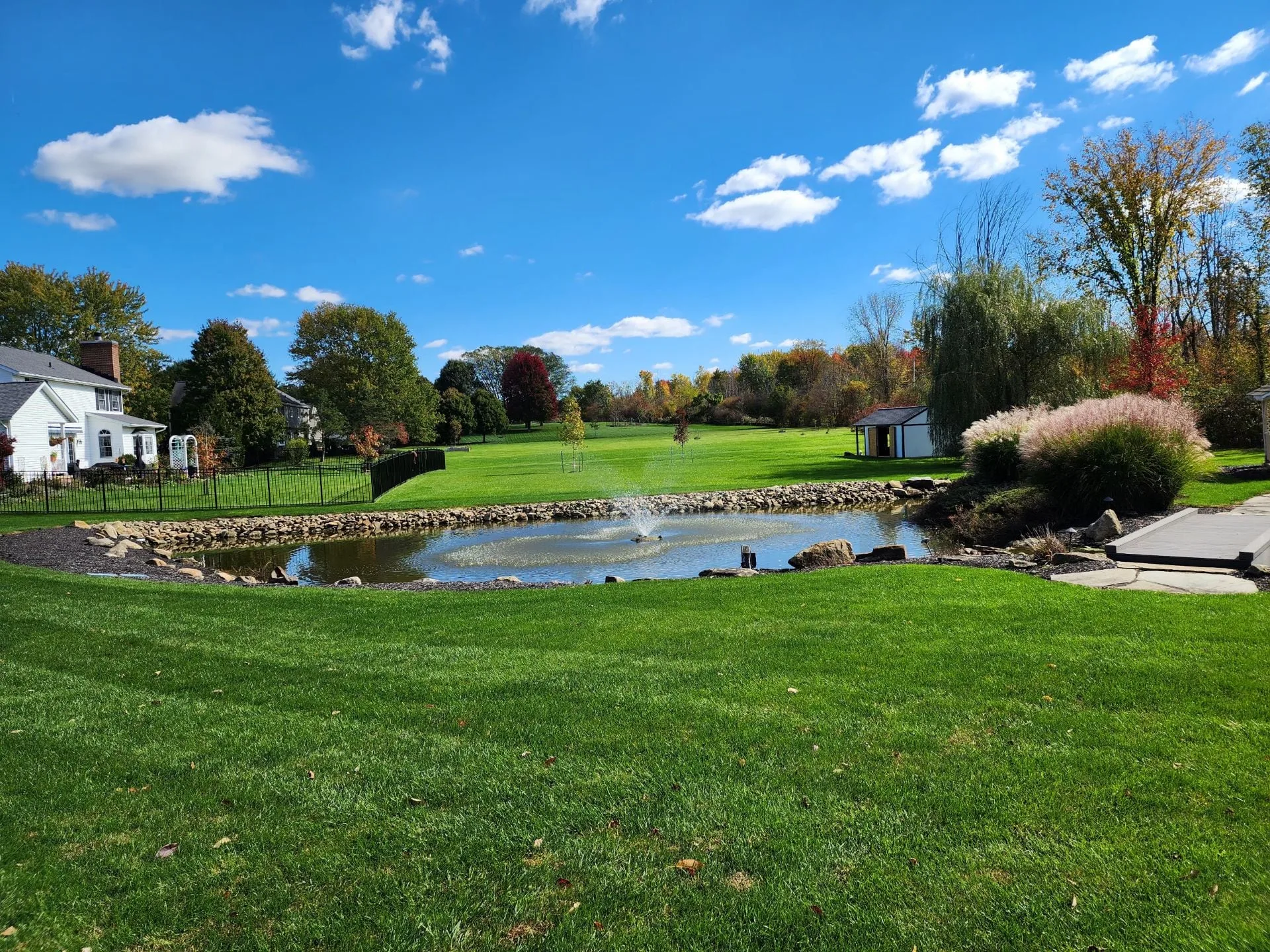
Mowing your lawn is more than a Saturday ritual. Getting the mowing height right for your grass type and the season is one of the simplest ways to keep turf dense, green, and weed-resistant in Ravenna, Hudson, Kent, and across Northeast Ohio.
Portage Turf & Pest provides lawn care services focused on fertilization, weed control, aeration, and seeding — not mowing as a service. Still, the height you leave after each cut supports everything else we do for your yard.
Why mowing height matters
Deeper roots
Taller blades support deeper roots that access water and nutrients, handle drought better, and compete more effectively with weeds.
Better photosynthesis
Leaf tissue is how grass captures energy. Cutting too short reduces the plant’s “solar panel” and slows recovery after heat, traffic, or dry spells.
Natural weed suppression
A thicker canopy shades the soil and makes it harder for weed seeds to germinate.
Moisture retention
Taller turf shades the soil surface, slows evaporation, and helps clay lawns common in Portage and Summit counties hold moisture more evenly.
Recommended heights for Northeast Ohio
Cool-season mixes dominate most local lawns:
| Grass type | Typical height |
|---|---|
| Kentucky bluegrass | 2.5–3.5 inches |
| Perennial ryegrass | 2.5–3.5 inches |
| Tall fescue | 3–4 inches |
| Fine fescue | 2.5–3.5 inches |
In summer heat, stay toward the high end of the range. A short “golf course” look on Ohio clay usually costs more water and invites stress.
Best practices
Follow the one-third rule
Never remove more than one-third of the blade in a single mowing. If growth got ahead of you, bring height down over two or three cuts instead of scalping.
Keep blades sharp
Dull blades tear tissue, brown the tips, and open paths for disease. Sharpen at least twice per season — more if you mow large lots or often.
Vary your pattern
Change direction each visit to reduce compaction tracks and encourage upright growth.
Mow when dry when you can
Wet grass clumps, cuts unevenly, and can spread disease pathogens on the mower.
Seasonal adjustments
Spring: Start mid-range to encourage green-up, then raise as temperatures climb.
Summer: Highest recommended setting during hot, dry stretches.
Fall: Keep height through early fall so roots store energy. The final cut of the year can drop slightly to reduce snow-mold risk — still avoid scalping.
When (and when not) to lower the deck
Lower the deck only when you have a clear reason: preparing a thin area for overseeding under guidance, evening out after a stretch of tall growth (gradually), or a late-fall tidy cut. Do not lower the deck to chase green color in July heat or after drought — that usually makes stress worse.
If bare patches or traffic lanes are the real problem, height alone will not fix them. Look at core aeration, seeding, and your watering habits.
How professional lawn care fits in
Proper mowing pairs well with a planned fertilization and weed program, grub control when pressure is high, and soil work when clay stays compacted. For more homeowner habits beyond the deck setting, see proper mowing and more.
Bottom line
Choose a mowing height that matches your grass type, keep most of the leaf in summer, and adjust slowly — not with one aggressive cut. That habit alone protects color, roots, and weed resistance on Northeast Ohio lawns.
Questions about your turf or a full-season program? Request a quote or call (330) 296-8873.